
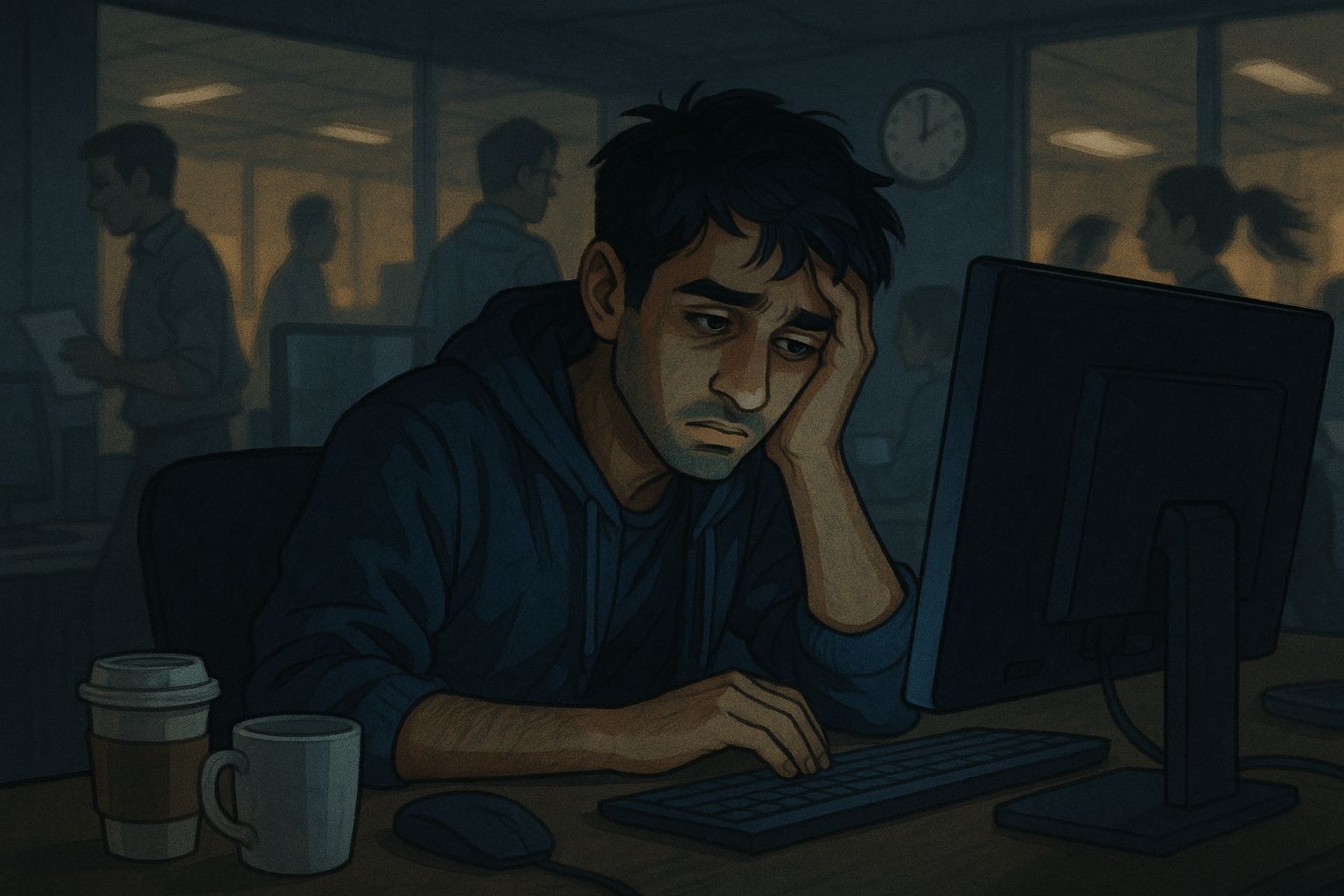
When work stops being “just stressful” and starts costing you your mental health
You told yourself it’s just a busy phase.
Once this project ends, once this appraisal cycle passes, once things settle down, you’ll feel better.
But weeks turn into months. You wake up already tired. You push through the day on autopilot. Even after logging off, your mind doesn’t shut down. You feel irritable, disconnected, and strangely numb. Weekends are spent recovering, not living.
- This is not laziness.
- This is not a lack of motivation.
- This is not you being “bad at handling pressure.”
This is what work-related stress slowly turning into burnout looks like.
When stress becomes the norm
In India, work stress is so normalised that many people don’t recognise it as a problem until their body or mind forces them to stop.
According to the Indian Psychiatric Society, nearly 70 to 80 percent of Indian professionals report experiencing significant workplace stress, and close to one in two shows symptoms of anxiety or depression linked to their job.
India also ranks among countries with the longest working hours globally, with many urban professionals working well beyond 48 hours a week. Productivity is rewarded. Rest is often seen as optional.
Over time, this constant pressure does not just exhaust the body. It dysregulates the nervous system.
Stress vs Burnout: why this distinction matters
Stress usually feels like pressure. There is urgency, worry, and overload, but there is still emotional engagement. You still care.
Burnout is different.
The World Health Organization defines burnout as a syndrome resulting from chronic workplace stress that has not been successfully managed. It is characterised by emotional exhaustion, mental distance from work, and a reduced sense of effectiveness.
Burnout doesn’t always look like panic or breakdown. Often, it looks like numbness, disengagement, and quiet exhaustion.
People stop feeling anxious because they stop feeling much at all.
How Indian work culture fuels burnout
Work-related burnout in India is not an individual failing. It is deeply linked to systemic and cultural factors.
There is a strong overwork culture, where long hours are equated with dedication. Leaving on time can feel risky. Setting boundaries can feel selfish.
With remote and hybrid work, work-life boundaries have blurred further. Messages, calls, and emails continue late into the night. The brain rarely enters a state of rest.
Job insecurity adds another layer. Rapid market changes, layoffs, and competition create a constant fear of being replaceable. Many people overwork not because they want to, but because they are scared.
Despite increasing awareness, mental health stigma still exists, especially in professional spaces. Many hesitate to seek therapy, worrying it may affect how they are perceived.
Definition, statistics, and contributing factors
Work-related stress refers to the physical and emotional responses that occur when job demands do not match a worker’s resources, needs, or capabilities.
Burnout is a more severe, chronic outcome of unmanaged workplace stress.
A large epidemiological study published in The Lancet Psychiatry reported that nearly 197 million people in India were living with mental disorders, with anxiety and depressive disorders being the most common. Urban working populations showed a higher burden, strongly linked to occupational stress.
Research link:
https://www.thelancet.com/journals/lanpsy/article/PIIS2215-0366(18)30222-X/fulltext
Another study examining workplace stress found a strong association between high job demands, low autonomy, and symptoms of anxiety and depression. Employees with little control over their schedules or decisions experienced higher emotional distress, regardless of salary.
These findings reinforce one key point. Burnout is not about resilience. It is about prolonged exposure to unhealthy environments.
Psychological and physical impact of chronic work stress
Long-term workplace stress affects more than mood.
It alters sleep patterns, concentration, emotional regulation, and immune functioning. People report insomnia, constant mental fatigue, irritability, emotional sensitivity, and reduced motivation.
Physically, stress often shows up as headaches, gut issues, muscle tension, body pain, and frequent illnesses.
Emotionally, many experience self-doubt, loss of confidence, detachment from work they once enjoyed, and a growing sense of meaninglessness.
This is often dismissed as “just adult life.” It is not.
Why burnout often goes unnoticed
Burnout is quiet. It doesn’t always involve visible breakdowns. People continue showing up, performing, and meeting deadlines, while feeling empty inside.
Culturally, many are taught to tolerate discomfort and push through. Emotional distress is minimised or compared to others who “have it worse.”
By the time help is sought, burnout has already taken a deep toll.
Do’s and Don’ts to protect your mental health at work
Even understanding psychology doesn’t make anyone immune. Our brains are wired to respond to pressure, reward, and fear.
The goal is not perfection. It is awareness and course correction.
✅ DOs
Create clear work boundaries and communicate them early. Your nervous system needs predictability to feel safe.
Take regular breaks without guilt. Rest is not laziness. It is recovery.
Notice early signs of exhaustion.
Irritability, numbness, and constant fatigue are signals, not weaknesses.
Prioritise sleep and routine.
Burnout worsens when the body never fully resets.
Seek professional mental health support.
Therapy helps regulate stress responses, rebuild boundaries, and prevent long-term damage.
❌ DON’Ts
Don’t normalise chronic exhaustion. Feeling tired all the time is not normal.
Don’t ignore emotional numbness.
Detachment is often a sign of burnout, not strength.
Don’t wait for a breakdown to seek help.
Early intervention prevents deeper psychological harm.
Don’t tie your self-worth entirely to productivity. You are more than your output.
The HALT check-in for work stress
Before pushing yourself further, ask:
H – Hungry A – Angry L – Lonely T – Tired
If any apply, pause. These states lower emotional regulation and increase burnout risk.
Final thoughts
Work-related stress and burnout are not personal failures. They are signals from a system that demands constant output without adequate care.
Mental health is not a distraction from work. It is the foundation that allows people to function, grow, and sustain their careers without losing themselves.
If work has started costing you your peace, sleep, or emotional well-being, it deserves attention.
Support exists. And asking for help is not a weakness. It is wisdom.

Author: Prishika Jain,
Counselling Psychologist,
Harmony Mind Clinic.
References
- Patel et al. The burden of mental disorders across the states of India. The Lancet Psychiatry.
https://www.thelancet.com/journals/lanpsy/article/PIIS2215-0366(18)30222-X/fulltext
- World Health Organization. Burnout as an occupational phenomenon (ICD-11).
https://www.who.int/news/item/28-05-2019-burn-out-an-occupational-phenomenon


